
Every number has a shape. Primes are towers.
Build any number out of cubes and let it fold into its most compact form — its prime shape. Primes stay stubborn towers. Composites fold into plates, bricks, and cubes. Suddenly factors, volume, and surface area are things you can stack, spin, and see.
+Surface
Minimize exposed faces while keeping volume fixed.
+Spatial
Rotate, zoom, and compare shapes in 3D to build intuition.
+Math talk
Connect factors, primes, and efficiency to real geometry.
Why prime shapes?
Math that you can stack, spin, and see.
- ◆
Surface area efficiency. Prime shapes expose the fewest faces, showing students the cost of stretched dimensions.
- ◆
Factor sense. Each dimension is a factor of N. Students see why certain triples pack tighter.
- ◆
Cube-first visuals. N is literal: one cube = one unit. No abstractions required.
the shape family tree
Every number in the universe is one of these shapes.
Count a number's prime factors and you know its silhouette. That's the whole system — and it never breaks.

1 prime factor
Towers
7 = 1×1×7. Primes are so stubborn they only make a tower — you can see primality.
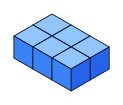
2 prime factors
Plates
6 = 1×2×3. Two primes make a flat slab — one layer thick, every time.
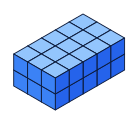
3 prime factors
Pure bricks
30 = 2×3×5. Three primes, three dimensions — every edge is a prime number.
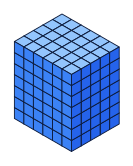
4+ prime factors
Fused bricks
210 = 5×6×7. Four primes won't fit in three dimensions — two of them must fuse.
Why can't two dimensions fuse at once? That's a theorem — and a fun one. Dig into the math →
fresh from the lab
Discoveries hiding in plain sight.
We computed the prime shape of every number up to 200,000. The blocks had surprises waiting.
The number that lies
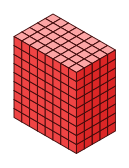
5×8×9 · SA 314
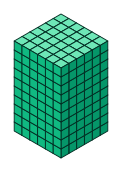
6×6×10 · SA 312
360 breaks intuition. The cube-like 5×8×9 loses to 6×6×10. "Closest to cube" and "least surface" aren't the same thing — only 65 numbers below 50,000 expose the difference.
An open problem
200,000 checked
No ties. Ever. In every number we've tested, exactly one shape wins the surface-area race. Nobody has proven it must be unique. Find a tie — or prove none exists — and you've done real mathematics.
The great reshuffle
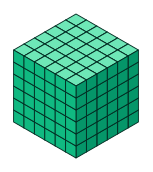
216 = 6×6×6
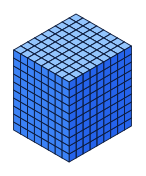
720 = 8×9×10
Numbers reorganize. Double 216's perfect cube and every dimension changes. And 720 folds into 8×9×10 — three consecutive numbers. The primes re-deal themselves for maximum balance.
featured walkthrough
Prime Shapes in action
Prime shape basics
Fast rules for the 3D blocks you’ll build.
- •We always build 3D, six-sided rectangular blocks made of unit cubes.
- •Dimensions multiply to N (volume is fixed).
- •Prime shape = the arrangement with the least surface area.
- •Ties go to the shape closest to a cube; axes ordered Height ≥ Width ≥ Depth.
Rules
See the criteria that define the “prime” 3D block for any N.
Getting started
See example shapes, prime towers, and explorer tips.
Benefits
Why turning numbers into stacked cubes unlocks intuition.
FAQ
Answers for teachers, parents, and students.
Full explorer
Dive into the tool on its own page for classroom demos.
Studio
Watch scripted cube scenes — the animation rig behind our videos.
hands-on tool
Prime Shapes Explorer
Enter a cube count, adjust dimensions, and discover the most compact arrangement.
Keep exploring
Want more context?
Read the full rules, see the benefits, or skim the FAQ—then come back here to build.